Starting the Season
The start of the season ("kickoff day") is one of the most exciting days of the season. Other than tournaments, this day is the day with the most moving parts.
Before kickoff day
Several members of the team should read Game Manual part 1 (part 2 is released along with the animation on kickoff day). GM1 involves everything not game-specific. This includes definitions, explanations, allowed and disallowed resources and actions, how scores and judging works, awards and more.
It will seriously benefit your team if someone on your team learns how GM1 and GM2 work so you know where to look for rules.
You should also buy the field, tiles, and walls from Andymark. Save the boxes for the prototyping process
Reach out to your state's FIRST Tech Challenge office and find out if they have a "kickoff day" event. If so, you should attend. They will have the field where you can touch, feel, measure, and mess with the field before it arrives at your workshop. They will also have someone there who really understands the rules and will be answering questions.
Use this form to find local contacts:
Loading...
Start by watching the game animation
FIRST will put out an animation of the most basic rules of the game. Each of the missions, the general rules, and will set the vibe for the season.
Watch the game animation as many times as necessary for your team to get an idea for how the game will work.
Don't worry about reading game manual part 2 in-depth, but have it availible to answer specific rules questions while discussing the animation (https://www.firstinspires.org/resource-library/ftc/game-and-season-info).
Attend an in-person field demonstration
This only applies if one is being offered in your region, but you will be able to ask specific questions to that region's head referee who truly understands the rules.
Develop your initial strategy
This is one of the single most important things you will do this entire season and should not be taken lightly. There are many ways to define a strategy, but this is how my teams have broken it down, and is how I suggest you determine your strategy.
Begin by drawing a graph on paper. The x axis of your graph should be percieved difficulty of the challenge, with easy on the left, and difficult moving towards the right. The y axis should be the point value of the challenge. As you draw your graph, your strategy will evolve farily naturally.
note
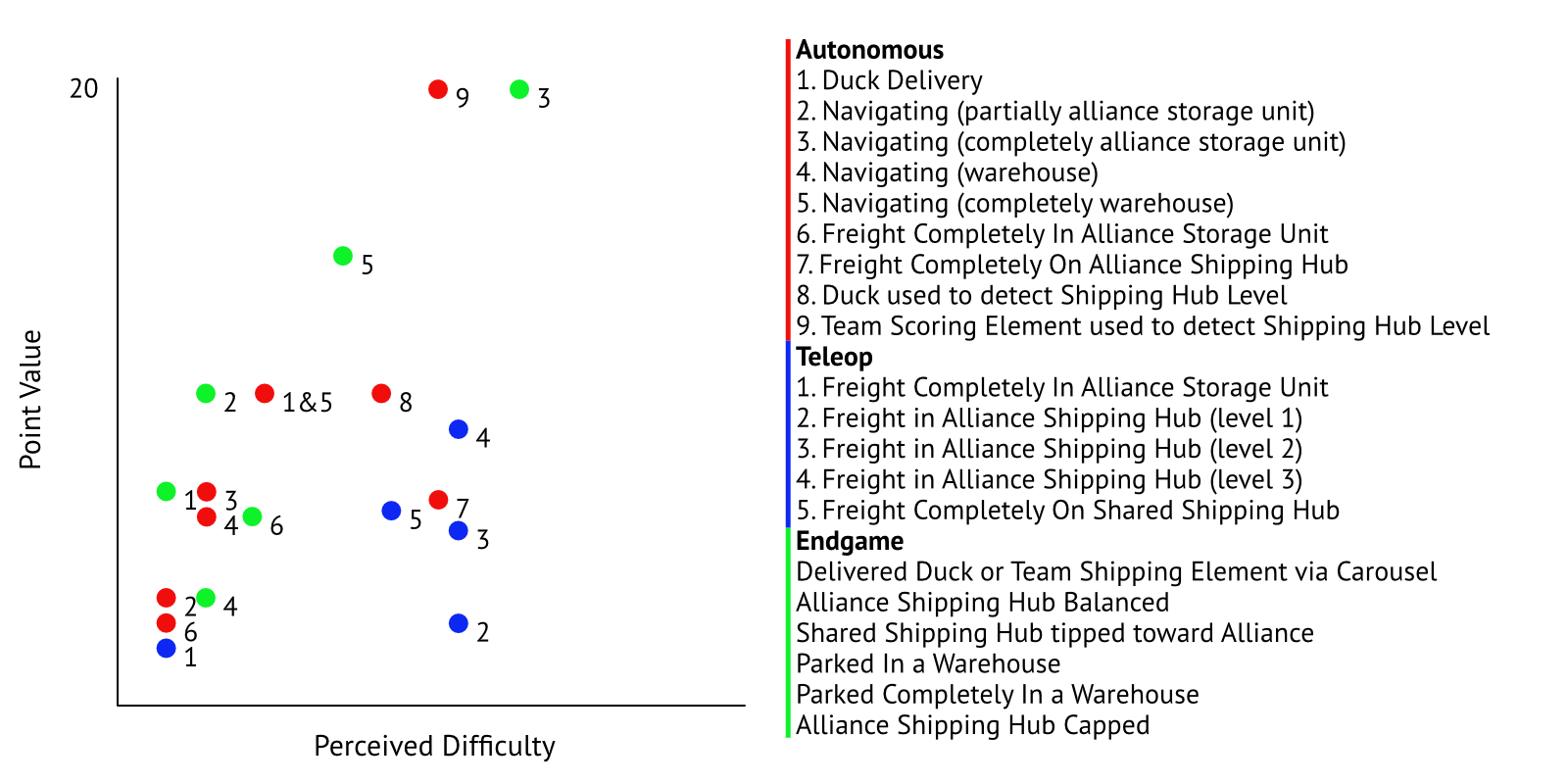
This was our strategy graph from the Freight Frenzy season. You can see how it helped us identify what missions were worthwhile, and which were not. For example, the blue dot labeled '2' in the bottom right would not be worthwhile because it is a difficult mission worth very few points. However, the red dot labeled '9' in the top left would be a good choice because it is a relatively easy mission worth a lot of points.
These strategy graphs are different from team-to-team as each team will have people with different skills.
Once you have this strategy graph written down, you can start to develop your strategy, finding the right spot between difficulty and point value, then compile seperate ordered lists for autonomous, teleop, and endgame. These should be ordered from 'most worthwhile' to 'least worthwhile'.